Part 1:Introduction to ethics and theology
We make the mistake of using only our intellect to understand deen and we forget about our hearts. If you listen to the story of converts, most converts were guided by their hearts.
STUDY OF RELIGION
1)FAITH BASED (CONFESSIONAL)
Faith based study of religion is based on personal faith so certain things are not allowed to be questioned e.g. Allah,prophethood etc. It is based on the confession that you believe in the foundations of faith.
2) SECULAR
Secular approach necessitates that you don’t bring your belief in Allah in your study of religion, and you keep your mind open to the possibility of disbelief. It involves questioning everything including God,prophets, afterlife etc
3)DIVINITY SCHOOL APPROACH
If we combine both these approaches, we get the divinity school of approach which is open to questions but does not question Allah Himself or the very foundations of belief. Divinity school of approach uses faith based education combined with modern education and it involves an analytical approach to Islam but not a critical approach in which the foundations are criticised.
CRITICAL VS ANALYTICAL
Critical thinking is a good thing in itself. But, we should not be willing to critique Allah, the Qur’an, and the Messenger. The word analytical is more preferable because we embark on an academic study without criticising the core foundations of Islam.
THEOLOGY
Aqeedah= creed e.g. in Sunnis, aqeeda tahaviya is most popular. It consists of basic sets of beliefs about Allah, Prophethood, angels, scriptures etc.
Another book on aqeedah is by Imam Ghazali RA (Al Risala Qudsia)
Ilm ul Kalaam= Dialectical theology,analytical approach trying to understand matters of faith. e.g. What does it mean that Allah has zaat and sifaat?freewill and predestination? Why did Allah create evil? Why did Allah create eternity? All of these discussions are in ilm ul kalaam but they are based on the Quran and Sunnah.
WHAT IS DEEN?
كَانَ النَّبِيُّ صلى الله عليه وسلم بَارِزًا يَوْمًا لِلنَّاسِ، فَأَتَاهُ جِبْرِيلُ فَقَالَ مَا الإِيمَانُ قَالَ " الإِيمَانُ أَنْ تُؤْمِنَ بِاللَّهِ وَمَلاَئِكَتِهِ وَبِلِقَائِهِ وَرُسُلِهِ، وَتُؤْمِنَ بِالْبَعْثِ ". قَالَ مَا الإِسْلاَمُ قَالَ " الإِسْلاَمُ أَنْ تَعْبُدَ اللَّهَ وَلاَ تُشْرِكَ بِهِ، وَتُقِيمَ الصَّلاَةَ، وَتُؤَدِّيَ الزَّكَاةَ الْمَفْرُوضَةَ، وَتَصُومَ رَمَضَانَ ". قَالَ مَا الإِحْسَانُ قَالَ " أَنْ تَعْبُدَ اللَّهَ كَأَنَّكَ تَرَاهُ، فَإِنْ لَمْ تَكُنْ تَرَاهُ فَإِنَّهُ يَرَاكَ ". قَالَ مَتَى السَّاعَةُ قَالَ " مَا الْمَسْئُولُ عَنْهَا بِأَعْلَمَ مِنَ السَّائِلِ، وَسَأُخْبِرُكَ عَنْ أَشْرَاطِهَا إِذَا وَلَدَتِ الأَمَةُ رَبَّهَا، وَإِذَا تَطَاوَلَ رُعَاةُ الإِبِلِ الْبُهْمُ فِي الْبُنْيَانِ، فِي خَمْسٍ لاَ يَعْلَمُهُنَّ إِلاَّ اللَّهُ ". ثُمَّ تَلاَ النَّبِيُّ صلى الله عليه وسلم {إِنَّ اللَّهَ عِنْدَهُ عِلْمُ السَّاعَةِ} الآيَةَ. ثُمَّ أَدْبَرَ فَقَالَ " رُدُّوهُ ". فَلَمْ يَرَوْا شَيْئًا. فَقَالَ " هَذَا جِبْرِيلُ جَاءَ يُعَلِّمُ النَّاسَ دِينَهُمْ ". قَالَ أَبُو عَبْدِ اللَّهِ جَعَلَ ذَلِكَ كُلَّهُ مِنَ الإِيمَانِ.
Narrated Abu Huraira:
One day while the Prophet (ﷺ) was sitting in the company of some people, (The angel) Gabriel came and asked, "What is faith?" Allah's Messenger (ﷺ) replied, 'Faith is to believe in Allah, His angels, (the) meeting with Him, His Apostles, and to believe in Resurrection." Then he further asked, "What is Islam?" Allah's Messenger (ﷺ) replied, "To worship Allah Alone and none else, to offer prayers perfectly to pay the compulsory charity (Zakat) and to observe fasts during the month of Ramadan." Then he further asked, "What is Ihsan (perfection)?" Allah's Messenger (ﷺ) replied, "To worship Allah as if you see Him, and if you cannot achieve this state of devotion then you must consider that He is looking at you." Then he further asked, "When will the Hour be established?" Allah's Messenger (ﷺ) replied, "The answerer has no better knowledge than the questioner. But I will inform you about its portents.
1. When a slave (lady) gives birth to her master.
2. When the shepherds of black camels start boasting and competing with others in the construction of higher buildings. And the Hour is one of five things which nobody knows except Allah.
The Prophet (ﷺ) then recited: "Verily, with Allah (Alone) is the knowledge of the Hour--." (31. 34) Then that man (Gabriel) left and the Prophet (ﷺ) asked his companions to call him back, but they could not see him. Then the Prophet (ﷺ) said, "That was Gabriel who came to teach the people their religion." Abu 'Abdullah said: He (the Prophet) considered all that as a part of faith. (Bukhari)
Foundation of deen is based on Hadith e Jibreel.
Hadith of Jibrael AS: Deen= imaan(Ilm ul kalaam) +Islam(Ilm ul fiqh)+Ihsan(Ilm ul tazkiyah)+signs of end of times and coming of akhirah(social realities)
-
Ilm ul kalaam is the study of Iman. Ilm ul kalaam are the analytical discussions based on Quran and Sunnah
-
Ilm ul fiqh is the study of Islam. Ilm ul fiqh is the textual understanding of Islam based on Quran and Sunnah about how to follow deen practically
-
Ilm ul tasawwuf/tazkiya is the study of Ihsan. Ilm ul tazkiyah and tasawwuf is about creating feelings of Ihsan, to stand before Allah as if we are looking at him or He is looking at us.
Let's take an example of a sign of end of times: a slave girl giving birth to her mistress. If we take the literal meaning, it seems far fetched that a slave girl would become free and then enslave her own mother. If we take an analytical meaning, we can get a wide meaning that it implies the upheaval of social order and family values and it implies that the daughter will be disrespectful towards her mother. Or we can turn the knob further and say that it refers to general social chaos and upheaval. So we can turn the knob to zero and take the literal meaning or turn the knob to one and take a deeper meaning.
The barefoot,destitute shepherds will compete with one another. If we keep the knob at zero, they have to be literally naked and barefoot. But if we take an analytical approach, we can imagine that poor people are now building skyscrapers e.g. in dubai and Saudi arabia where poor people are being used to build skyscrapers. If turn the knob completely, we can get a broader meaning of competition to pursue material ends and materialism.
WHAT IS IMAAN?
Building the workshop
Even if I have to answer just one question e.g. What is Imaan, we would have to build a workshop and use all the verses, hadith, historical aspect, context, texts, spiritual realm, linguistic meanings, usage in arabic, all the things that can increase and decrease the feelings of imaan, and the people who were spiritual embodiments of imaan. It is a multilayered approach. It is not simple at all. We have to bring EVERYTHING to the table to come to the conclusion.
Definition involves making a border and defining something precisely and specifically to include all elements of that set and excludes all elements outside of that set. So imaan needs to be defined so precisely so that people of Imaan are included and others are excluded. There exists a multiplicity of meanings in deen. Some people get confused by disagreements and don't understand that there can be multiple meanings even for something like imaan.
 Verse 2:286 says to believe in everything that was revealed to Prophet SAWW, and this means belief in the UNSEEN. To believe in the unseen as if it was seen= Iman. Faith means belief in the unseen,belief in the ghayb. Shahada means to believe in something seen and we say the shahada when accepting Islam, which means we have to believe so strongly as though we can see it. Atheists believe in empiricism i.e. belief in things that can be seen or observed.
Positions on Imaan?
-
Heart - a feeling that lies in the heart only
-
Tongue - expression of imaan with their tongue by saying the kalimah
-
Heart+tongue - truly believe in their heart and express on tongue
-
Heart+tongue+actions - believe in heart, express with their tongue and manifest in their actions
If we take imaan as just something in the heart, then it would be incomplete.
If we take it as just something from the tongue, then niyyah and heart would be disregarded.
If we take heart plus tongue plus actions then that would leave a very narrow definition of imaan and everybody would be kicked out of imaan.
When we have multiple positions, we either have to find common ground(tatbeeq) or give preference to one position(tarjeeh). The conclusion of the workshop was that imaan should be in the heart but it should be professed from the tongue.
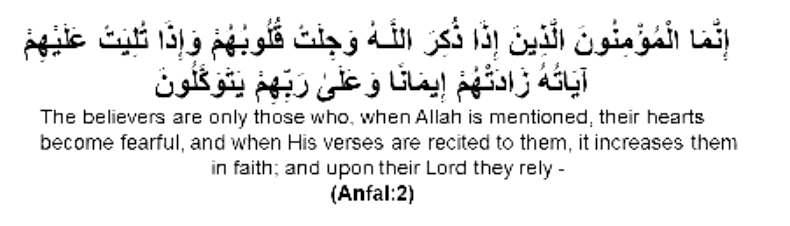
This is an ayah about imaan increasing and decreasing. When Quran is recited, their hearts tremble and their imaan goes up. So that means imaan is variable in intensity. Some people think quality of imaan goes up and down and some think quantity of imaan goes up and down. Imam shaafi thinks its quantitative and units of imaan go up and down. Imam abu hanifa thinks quality and passion of imaan goes up and down.

This ayah says that don't say you have imaan, say you have Islam. So what is the difference between Islam and Imaan? One position is that Islam and Imaan are identical when used separately and are different when used together, together imaan means what's in the heart and islam means the outward practices.

The hadith says nobody does adultery while being a momin. Does that mean Imaan leaves the heart if we commit major sins? Does this apply only to adultery or to all major sins? Does the Iman return after completing the act of sin?

This hadith says that Iman has branches. Does that mean imaan has components? What are the components? Do we need to have all components?
We need to build a workshop to answer all of these questions.
BOUNDARIES OF IMAN
INCLUSIVISM
Everyone who calls himself a Muslim, has Islam
EXCLUSIVISM
Some people are excluded from Islam e.g. all Ulema agree that a person is excluded from Iman if he believes there is another Prophet after Prophet ﷺ. We can coexist peacefully with groups who have these beliefs, but these groups should not claim to be a Muslim. A Muslim cannot claim to be an Orthodox Christian. A Jew cannot open a synagogue and call it a church. A muslim cannot call his mosque a Catholic church. It is not freedom of religion to claim someone else’s identity.
PLURALISM AND TOLERANCE
There are many theological sects in the Muslim world. How do you set boundaries?
Recommended reading: Boundaries of theological tolerance in Islam - Dr Shermen Jackson (OUP)
Ilm ul kalaam is the study of Iman. Ilm ul kalaam are the analytical discussions based on Quran and Sunnah
Ilm ul fiqh is the study of Islam. Ilm ul fiqh is the textual understanding of Islam based on Quran and Sunnah about how to follow deen practically
Ilm ul tasawwuf/tazkiya is the study of Ihsan. Ilm ul tazkiyah and tasawwuf is about creating feelings of Ihsan, to stand before Allah as if we are looking at him or He is looking at us.
Heart - a feeling that lies in the heart only
Tongue - expression of imaan with their tongue by saying the kalimah
Heart+tongue - truly believe in their heart and express on tongue
Heart+tongue+actions - believe in heart, express with their tongue and manifest in their actions
