Surah Alaq was about HOW revelation began. Sarah Qadr followed it with WHEN revelation began. Surah Bayyinah is about the essence of revelation.
Munfakkeen means to discontinue, or stop doing something OR people who cut themselves off.
The people who disbelieved were not going to quit it until Bayyinah came.
BUT Allah did not mention what they quit?
Infakka is similar to intaqa which means to stop doing something or it also means to be painfully separated(e.g. a dislocated shoulder) or it also means to be cut off
Mostly scholars say that it is a madni but it could also be late makkkii
What were they not going to stop? One opinion is that it points towards kufr and shirk, but HATTA implies that they later stopped it, which they didn't, so it doesn't make sense?
A scholar said that maybe the mushrikeen demanded a visible miracle for them to give up their shirk, they didn't believe in the Quran but wanted an apparent miracle? For them, THIS was bayyinah. So this scholar thinks that in the first ayah Allah is basically repeating their challenge. And the second ayah is in response to their challenge that a messenger was sent to them who recites scriptures to them.
MIN ahli kitaab wal mushrikeen could be min tabeezia which means that not all people disbelieved. MIN could also mean that ALL of them disbelieved.
The impact of bayyinah was so powerful that it made people separate from their ways of kufr and leave generations old kufr. They would have never abandoned from their kufr until bayyinah came.
It could also refer to their own book, that the ehl e kitaab would not have abandoned their old book until clear guidance came.
Ka fa ra means to deny and reject. Allah used this word for people even before revelation came although rejection comes AFTER revelation. Why?
Ka fa ra also means to bury a seed deep into the ground. Every society is in the dark until hidaya comes. Kufr is a form of darkness.
There are different kinds of people in a society.
Good on the inside and good on the outside e.g. Hazrat Abu Bakr even before Islam
Good on the inside but they are covered with a lot of things that hide their good e.g. Hazrat Umar, Hazrat Hamza
People good on the outside but very corrupt on the inside e.g. Abu Jahl
People corrupt on the outside and inside e.g. Abu Lahb
This message is forceful enough to separate these different kinds of people and reveal their true character. The society became compartmentalised. Quran is very uncompromising and unforgiving about shirk so there was no option but for people to be separated between imaan and kufr. Allah's destruction will fall upon those who reject the truth and Allah will bless those who accept the truth. Every society has a mix of people so Allah distinguishes the filthy from the good so that Allah can separately punish the evil in the society.
Bayyinah comes from bana yabeenu which means to put distance between two things clearly. It is the criterion.
Then Allah says Rasoolun, the tanween makes the translation a "a wonderful messenger". A messenger came who read ayahs to them. He was the practical demonstration of the Quran. This is the problem in this era that we invite people to Islam today with theory only but we lack practice and true character. Our actions do not match with our words.
Yatlu means to read out/recite something. But the Prophet SAWW did not know how to read and write?
The Quran was in the lauh e mahfooz written down. Then Angel Jibreel brings it down and reads it to Prophet SAWW. Prophet SAWW used to read it from his heart as the scriptures were written in his heart. He used to read the purified scriptures from a cleansed heart.
Tilawah also means to follow as our eyes follow the text, and it is also used for sun as it follows the moon.
In those scriptures, were kutubb, kutb refers to laws as it was used for books with laws but there is more to the scriptures than just laws. But there was more than just laws as Allah says, IN IT there are laws(which means laws are a part of it). Qayyim refers to setting something straight so the book sets straight the crookedness in a society. It also means to get rid of laws. Allah uses the word kutb himself for laws e.g. kutiba alaiykum qitaaal/siyaaam etc and is used for things that were made binding on us.
The next ayah refers to people who became disunited after the messenger came, as the jews and christians were told of the signs of the last Prophet SAWW and they knew about his advent yet they fell into disagreement after seeing the Prophet SAWW and still disbelieved.. This ayah refers to a journey from light to darkness, while the first ayah was for people who came from darkness to light. Religious knowledge is a means of empowerment. The clearest proof should make people lose agreements, but the people fell into disagreement because their motive was ego and power and they lacked sincerity so they began competing with each other religiously.
Believing in Bayyinah means to humble yourself before the messenger and the message. The hardest part is humbling yourself in front of a messenger as humans like liberty and they don't like anyone with authority, and they like rebelling. People take Quran but don't take Sunnah. This is their ego. Revelation combined with messenger is a proof after which no argument is possible.
Ootul kitab. There are two ways of saying giving the book:Those who we gave the book OR those who were given the book. Whenever Allah says, those who were given the book and doesn't mention his own name then it usually is used with a negative connotation.Whenever Allah says those who WE have given the book, it is used for people who valued imaan and acted upon it and it has a positive connotation.
Now this Surah summarises the whole message of the Quran in the 5th ayah. What was commanded except that we obey Allah.
Abd is a slave AND a worshiper. But we translate ibadah as worshipping, but in reality it includes worship and slavery. Worship is at a certain time and place but slavery has no specific time and it is a state of being. Servant is also the wrong translation as service is an exchange of something, just like people work for different organisations with a certain job description in exchange for something/ There is a set job description. In slavery, we have to do everything the master says. Slavery is usually involuntary and service is voluntary.
Slavery includes(according to Ibn Tayyimah)
LOVE
OBEDIENCE
SINCERITY
TRUST/TAWAKKUL
TERMS OF SLAVERY
We unfortunately have a very negative connotation of slavery but this slavery of Allah is beautiful as Allah is the best master. This slavery is NOT forced but it is willing and out of desire. To be a slave of Allah, we need to love Allah and all other loves are part of submission to Allah and they are FOR the sake of Allah. There is no obedience to the creation while disobeying the creator. Then it includes sincerity because EVERYTHING becomes for the sake of Allah only. We have to have complete trust and tawakkul in Allah that whatever happens is FOR our own good. If you place your trust in people you will always be disappointed and if you trust Allah, then you will never be disappointed. Allah DECIDES the terms of slavery and we do not decide it. Allah defines the standards and terms of slavery and we have no say in them.
Mukhliseena lahuddeen means exclusively and sincerely for Allah. When our ego comes in our deen,we lose our sincerity and we start doing things for the wrong reasons. We even bring ego into our deen and sometimes we search for worldly appreciation while doing something for deen. When you get used to being praised all the time, and sometimes someone criticises or insults you, you take it personally and your ego comes up. Remember the Prophet SAWW who was criticised and ridiculed a million times and called insane, a liar, a magician. Religion can even become a fight of recognition. Bani Israel also rejected Prophet SAWW because they thought they were superior in religion.
Hanaf means to incline away from misguidance towards guidance. Jannaf has the opposite meaning to jannaf. Hannaf is someone who is not distracted by anything in religion.
Salaah refers to ibadaat and zakat refers to mamulaat so it a summary of deen as deen consists of ibadat and mamlaat.
Deen ul qayyima means truly established religion. OR this is the religion of the established nation. This deen will have victory at the end,definitely in the akhirah.
The Surah began with the discussion of mushrikeen. Some people want to stay in kufr even after getting bayyinah. Such people will be in the fire of hell. Jahannum is from persian language and it means torture chamber. Khuld means to remain permanently in something.
Inna is used when the audience is unsure, so Allah uses anna to emphasise his point.
The most expensive resorts and estates in the world have gardens and beautiful scenery and rivers and waterfalls. Allah promises us these things in Jannah because this is what everyone craves even in the most modern era.
For jannah, Allah uses the word abadan. Some people like Ibn Tayyimah thought that jahannum is not permanent but the majority believes that jahannum is also permanent. The reality is that abadan is also used for jahannum in the Quran. Allah sometimes describes jannah in greater detail and sometimes jahannum. When more detail is given to one group, more wording is used to one group.
Allah says they will remain in there permanently. Everyone in the world wants to own and wants desire for permanence and stability. There is no bills, maintenance, nothing to worry about! The dune is nothing compared to akhirah.
Riza means to be pleased to that point where there is no room for any disapproval or any unhappiness. Even people are never completely happy as they always have greater expectations and want something more from us. Allah is incredibly happy and pleased and that is the biggest gift for us. We will be completely happy too and we will never get bored.
Khashiya is the fear of something greater than yourself. We need to have khashiyah of Allah. We have to fear Allah and NOT society and people. We need to truly fear Allah.
Monday, June 13, 2016

Tuesday, June 7, 2016
Surah Falaq
Surah naas and Surah Falq are also interlinked very closely. Sarah Falq and Surah naas were revealed simultaneously by Allah. The vast majority considers these two Surahs madni because of the narrations about these Surahs. After Sulah Hudaiybiya, Makkans did not remain the biggest power and enemy, because Jews were a bigger problem in Madinah. The Makkans tried to engage in offence against Prophet SAWW. Labeeed bin Asim, was a member of Banu Quraiza and one of the best magicians. The people of Khyber came soliciting his help. He paid one of the servants of Prophet SAWW who brought to him a couple of hairs from the Prophet SAWW's comb and he does magic on it and then put it at the bottom of a well zoo arwaaan and buried it. Prophet SAWW felt mentally and physically disturbed and he became forgetful and felt burdened. He told Hazrat Ayesha RA that he was suffering from magic and two angels came in the form of human beings to him in a dream, and they said that sorcery has been done on him. They told Labeed bin Asim had done magic and how he did it. These angels recited 11 ayahs Surah Falq and Naas and told him to recite it on the 11 knots one by one and open the knots. After that he felt relieved and felt as if an ailment was removed. Some people say that the narration does not prove that the Surahs are madnee as they might have been revealed in Makkah period and the angels only reminded Prophet SAWW to recite them.
If we accept that Prophet SAWW was affected by magic, does that justify when people say that Prophet SAWW was involved in magic? NO. Prophet SAWW was not a magician but it is possible that he is affected by magic. If magic can have an affect on someone, does that mean that Allah does not have ultimate power? NO. Allah does have ultimate power but he lets things happen and he allows evil things to happen sometimes just to test people. e.g. Allah can allow magic to happen. Allah himself mentions magic and he mentions Harut and Marut two angels who used to teach magic and say we are just here to test you so don't try magic as it is kufr. But those people still learnt magic and still practised it and Allah punished them. But no one can harm EXCEPT if Allah lets people harm someone.
This is a miracle of the Quran because no one was aware of this magic before, but Allah clearly specified that they are doing magic on knots. There was no way of knowing this except wahy.
One sahaaabi thought these two Surahs are not part of the Quran, and they are Allah's word but just for protection and not a part of the Quran. But the majority is not of this opinion. Several narrations prove it. It is very common for sahaba to have an opinion that is different from all other opinions. SO we follow the majority and this should not confuse us. This also does not make any sahaba any less than others as it is an intellectual disagreement.
The one who's protection we are seeking is Mustaaz bihi and the one we are seeking protection from/escaping from is Mustaaz minhuu. Sarah Falq has many mustaaz minhu and one mustaaz bihi and Surah Naas has many descriptions of Mustaaz bihi and one Mustaaz mind. Sarah Falq is about things that are not under our control and those evils are outward and Surah naas is about actions of human beings and internal evils. Inward evils are stronger so a stronger protection and more desperate plea is made in Surah naas as its a bigger danger.
The first evil mentioned is from the one who was created, then from the night, and then from the one who blows on knots/sorcery so the evils shift from more generalised to more specific.
قُلْ أَعُوذُ بِرَبِّ الْفَلَقِ (Arabic)
Translation: Say: "I seek refuge with the Lord of al-Falaq. (Sūrat al-Falaq 113:1)
QUL has a different meaning in different contexts. Here, Allah wants humans to acknowledge their weakness in front of Allah as an act of humility. Qul removes arrogance, ujub and ego. Even ego is a kind of shirk. This is also a manifestation of our ikhlaas and sincerity. QUL is a command and when we follow it, we obey Allah. We can't ask Allah's help without obeying him so Qul teaches us to obey Allah. Musaa AS said to Allah that I seek refuge from Allah from everyone who has arrogance and who does not believe in the day of accounting. Arrogance comes when one's imaan is weak in the final day.
Istaaza means to cling to someone for protection because of fear of unseen dangers. Ijaara is the word used for protection against physical SEEN enemies. But Istaaza is for unseen enemies and intangible evil forces. Maaaz is a place where we find refuge e.g. when we say Maaaz Allah.
Aoozu means seeking refuge. It means we submit and give ourselves to Allah SWT for refuge and protection.
Falq means to rip something or tear something open. It is used for morning because the rays pierce the darkness(daybreak). Falq is also used for a seed when it rips open and a plant comes out. Falq is also used for rain coming out of clouds. It is also used for children which come out of womb. Falq includes all creation because all creation came OUT of something so it has the meaning of falq.
Rabaul Falq means that Allah owns the creation. This links it to Surah Ikhlaas because Surah Ikhlaas had the adjective Samad(the one who everybody needs but He is not in need of anyone). Surah Falq is the practical manifestation of Samad as we seek Allah and need him. Falq can also mean tearing problems open and expanding things for us by making ease.
Evil has always been associated with darkness and Towheed is associated with nooor. This Surah is about all evils which signify darkness, so ALLAH rips through the darkness by beginning the Surah with Falq which is the daybreak and the light tearing through all the darkness. Shirk is also darkness, and zulm means darkness literally and injustice figuratively, hence the ayah inna shirkaa lazulmun azeem.
One hadith also says that Falq is a door in hell which when opens, the heat tears everything apart. another narration says that Falq is a terrible prison in hell so even hell seeks refuge from it. So Falq can also mean punishment. The people who act on evils, their punishment is Falaq as Allah is the master of Falq.
113:2
From the evil of that which He created
Sharr is the opposite of Khayr.
Beesaa means when we think something is deplorable and it's opposite is Nemaa.
Saa-aa is something that is ugly/deformed/hideous and it's opposite is hasuna. (Sayyiaat and hasanaat)
Sharr universally and unanimously means something that is harmful and evil. Sharaara is the spark of the flame that can burn us. Sharr is basically the absence of good, just like darkness is the absence of light.
We seek refuge from the evil of what he has created, which implies that sharr exists in every creation, and everything Allah has created can have harm in it.
113:3
And from the evil of darkness when it settles
Ghasaq is the darkness after the sun sets. Ghaasiq is also used for that which sinks and disappears so it can even be used for the sun and the moon. Ghasaq can also be used for the dark sky when heavy rain is going to occur or for eyes which are dark because of crying.
Shayateen come out at night so night is a very dangerous time. Most sins are committed at night.
Waqab also refers to getting dark. Darkness is mentioned again to refer to so much darkness that things become invisible. It is like a ditch in the mountain at night. So there are hidden evils in the dark which can catch us off guard.
Ghaasiq is also used for moon because scientifically it is hypothesised that full moon often ignites certain evil aggressive behaviours and there are also many fantasy myths about it. Even lunatic comes from lunar.
We should try to stay at home at night and try to maximally avoid it.
113:4
And from the evil of the blowers in knots
Naffasaat refers to women who blow on knots. It can also be used to refer to groups which blow on knots together. Naffasa means to blow softly with some spit coming out, nafakha means to blow strongly like the blowing of the trumpet. Nafasa with a seen means to take a breath.
113:5
And from the evil of an envier when he envies."
Root of all the evils is mentioned at the end. Jealousy and Hasad leads to the evils mentioned previously. We can't stand others getting promotions or being superior to us. Children become jealous immediately so it is very important to curb this since the very beginning. Haasid is a hidden quality because it shows that the person has an element of hasad and hasada refers to him actively doing hasad. This is specifically about those who were jealous of the Prophet SAWW and even did magic because of it. Hasad is an unseen harm.
There is no room for jealousy in Islam except for a man who was given wealth and he is exhausting himself in destroying it in Allah's path, so he has an exceptional drive to GIVE. So we can do rashkk on such a person.It's hard for such a person to hold on to his money. Second is that person who has been given ilm by Allah and he teaches people wisdom. Wisdom is different from knowledge.
People even have jealousy in deeen. They compete negatively with people who are ahead of them in anyway in deep. Second jealousy exists among non muslims and kuffaar against muslims and they wish to drive muslims away from Islam. But our response should be to pardon people, forget it happened until Allah comes with his decision which will be ultimate. So we should not get fired up if nonmuslims plot something against us in jealousy.
Allah mentioned these specific sharrs because they have the potential to cause the most harm.
Why did Allah put alif lama before some evils and not before others e.g. haasidin, ghaasiqin, al-naffasaat? Allah made naffasaat proper because every single one of them is evil. Ghassiq is general because not every dark night is necessarily evil. Similarly, haasid may try to act on evil but may not necessarily do so. Secondly, this surah is specifically for nafasaat who did magic on Prophet SAWW so it has alif laam.
Imagine a farmer has a farm or a garden but insects or animals eat from that garden and destroy it. This is also a form of harm although the intentions are not evil. So when we seek protection from what Allah has created, it also includes these evils. Suppose he plants it in a place where there is no obstruction and no hidden problem, so this refers to the hidden problems that can face the person int he darkness of the night(ghaasiq). Then the last thing that can happen is that a person becomes overwhelms from outside sources just like a plant can be destroyed by flooding. The last evil that can occur is through an enemy so then the gardener seeks protection from such an enemy. So just like a gardener tries to protect his plant, we are taught to seek protection from all kinds of evil that can harm us.
Monday, June 6, 2016
Surah Naas
We should not try to give scientific rationale a higher place than Quranic revelation itself and we should not change the meaning of Quran just to make it more pleasing to others or to make it more scientific. People try to attack the hadith e.g. by saying that hadith were not compiled until around a 100 years after Prophet SAWW passed away, and the more authentic a hadith is the more fabricated it is and it has been covered up to make it seem authentic. Even some muslims doubt ahadith and say that they should not be used to interpret the Quran and they don't believe in context of revelation/shaan e nuzool.
The Quran was transmitted to us by the same sahaaba that transferred the ahadith. When you cannot trust them with ahadith, then you cannot even trust them with Quran? The Quran does NOT have contradictions but if we just look at ayahs without their context we will apparently find some contradictions, e.g. kill them wherever you find them vs. do not harbour animosity against anyone and treat them in the best way. Seemingly contradicting ayahs can be figured out when we look at their context, some surahs are mani some are makkki and the situation was different in these eras. Over simplification can lead to a lot of problems.
Surah Falaq was about outwardly sources of evil and Surah naaas is about the SOURCE of that evil i.e. Shaytaan. Allah not only protects us from evils outside ourselves as mentioned in Surah Falq but Allah also protects us from the evils inside us. The evils mentioned in Surah falq are out of our control, but those mentioned in Surah naaas are in OUR control as we can control our waswasa. Shaytan only invites us and WE are the ones who act upon it so this is a greater danger. The evils in Surah falq harm our dunyaa while waswasas harm our akhirah and imaan, so it needs to be guarded more. So we asked Allah's protection THRICE in Surah naas, we called Allah only once in Surah Falq.
The one we ask protection from is Mustaaaz bihi and the one we are escaping is Mustafa minhoo. The previous surah mentioned several mustaaz minhoo and one mustaaz bihi, and in this surah there is one mustaaz minhoo and several times mustaaz bihi is mentioned. That emphasises how strong this evil is and how strong a protection is needed.
قُلْ أَعُوذُ بِرَبِّ النَّاسِ
- Say, "I seek shelter with the Lord of the mankind"
QUL is an act of Allah's obedience and this is a means of seeking Allah's help and refuge. We can only seek protection after we have obeyed Allah's command. Declare your need for protection as this is a humbling experience as we admit that ONLY Allah can protect us.
The people are the one who need protection in this Surah that is why Allah used Rabbinaas. The Rabb of people. RABB has several implications. Rabb means absolute owner. e.g. owner of house, owner of slave. It is different from MALIK as Rabb has many meanings and includes SAYYED(one who has complete authority and charge) e.g. we can own a car and not have absolute authority over its make up. It also means MURABBI (it comes from tarbiyah, tarbiyah means to ensure the growth and maturity of something until it reaches the maturity where it can be productive) Murabbi is the one who ensures growth. Root word is Raa baa wow and this also comes in the duaa rabbirhamhuma kaman RABBAYANI sagheera. It is possible that we own something and don't take care of it e.g. the garden, our home maintenance. But Allah not only OWNS us but also takes care of us. Rabb also means MURSHID (guides towards proper usage, grant us rash and hidaya). It also means MUNIM(the one who gives gifts so whatever Allah gives is a gift and he doesn't owe us anything). It also means QAYYIM(the one ensuring existence of his subjects). So we only exist because Allah allows us to exist and nurtures us e.g. a very delicate plant only survives if we take care of it otherwise it will die if we don't water it.
RABB is the first name Allah used to introduce himself to Muhammad SAWW and Musa AS.Allah said Iqra bismi rabbikalazi khalaq. Allah Himself has introduced Himself as RABB. Allah said to Musa AS Inni Ana rabbukk and later said inane AlalAllah. Allah said in Surah Fatiha Alhamdulillahi rabbil aalameen. That is how important RABB is. The Quran begins and ends with RABB. The summary of Quran is to accept Allah as the master and ourselves as slave. We need to internalise it. This guidance will only benefit those who accept themselves as slaves. We have to say iyyaka nabudu wa iyyaka nastaeen and only then we can say ihdinasiraatul mustaqeem. The Quran begins and ends with the emphasis that Allah is our rabb and we are His ABD. When we say we are his slave, that put us under his authority and we need to follow Allah's guidelines to live our life. We have to live our life according to Quran.
مَلِكِ النَّاسِ
- King of mankind
One of the first realisation a child has is that his needs are being taken care of by his parents. MURABBI is one of the first realisations we have. Sometimes the problem is so big that parents cannot take care of it, then we need to go to the King/ Government. Then sometimes the problem is SO big that we can only ask ALLAH for help and have no one else to turn to on earth. There is a psychological progression. People tend to turn in dunyaa first to their loved ones and then to their king and higher authority and then to Allah. But Allah teaches us to go immediately first to our Rabb, we should turn for EVERYTHING to Allah. Ask Allah even if for a shoelace. So Allah fulfils all our needs so HE is our KING ALLAH and RABB.
There can be multiple caretakers in dunyaa but only one king in a country, but there is only one Allah in the whole universe so all these names have a logical progression and they become more and more specific to Allah. Allah cannot have ANY worldly implications as it is exclusively for Allah. It is a progression from more to less.
Caretaker can only take care of a few people, the king can take care of more people as he can watch over a country. Allah can watch over everyone. So NAAS is from qillat to qasrat as the people keep increasing. Allah does not repeat naaas just for beauty of language but it also has such hidden connotations.
Whenever we recite Quran, we should be seeking refuge from Allah as Surah Fatiha begins, and we also end Quran seeking Allahs protection.
Who is the biggest victim of Shaytaan? Firaun. Firaun claimed to to be the rabb of people. Then he said don't I own the whole kingdom. He also called himself the maalik. Firaun also said to his generals: I don't know of any other Ilaah for you than myself. So Firaun tried to claim Allah's position, all 3 positions. His biggest problem was arrogance and shaytaan can also put that arrogance within us and that is a major waswasa. In this world, people declare themselves their OWN master, their own king, their own Ilaah. They think they own themselves and have full control over their lives and their lifestyles. We become mini Firaauns when we have ego and we think we do whatever we like. Allah crushes this ego by saying us to seek his protection at the start of this surah.
One of the root origins of Naas is Nisyaaan which means forgetfulness. People forget the promise they made to Allah when Allah asked us Am I NOT YOUR RABB? Allah has given Shaytaan the ability to make people forget, and they even forget Allah when living their life. They forget Allah while committing sins. We ask Allah to be people of remembrance and not be people of forgetfulness. When we recite Quran we should seek Allah's refuge so that we are conscious and aware of Allah while doing every act. If the heart is filled with Allah's remembrance, then Shaytaan cannot enter it, but when the heart is an empty vessel and vacant, then Shaytaan will penetrate it and make us forget.
Allah has also repeated Naas to honour human beings by putting our name next to Allah's thrice.
MALIK is the authority of Allah. and the third name ALLAH includes both RABB and MALIK.
إِلَهِ النَّاسِ
- God of mankind
- From the mischief of the whisperer (of Evil, the Satan or the Evil one) who hides away (after his whispers
There is not anyone of you except that there is a constant partner assigned to him. Also with Muhammad SAWW. But Allah has aided Muhammad SAWW so he does not tell me anything but good. (mafhoom of hadith)
The messenger SAWW returned Safiyah RA to her home, and on the way two Ansar are walking by, and he tells his wife to stop and says that this is Safiyah. The sahaaba said why are you saying this, why are you explaining, we won't think anything wrong. Then our prophet SAWW said that shaytaan flows in us like blood and I feared he might put a waswasa in your heart. (mafhoom of hadith) Shaytaan also puts waswasa in our mind against Prophet SAWW and tries to turn us away from hadith and sunnah. People who don't have knowledge and don't remember Allah and leave a vacancy for Shaytaan are victimised by Shaytaan. Shaytaan plants an ego within our hearts that why should we follow Prophet SAWW, he is just a human like us, so why should we accept his authority over us. We don't like accepting authorities over us so we don't like the police, the boss, the teacher, the judge. So it's hard for us to accept Prophet SAWW as the ultimate authority, it is relatively easy for us because we are not in his era. But how hard was it for people who were in his time as now his friends and family have to accept him as the ultimate authority. People keep asking IS IT IN THE QURAN? They don't say is this in the QURAN AND SUNNAH? People remove the sunnah from the Quran and separate them.
SHARR is a harmful evil and a spark that can harm us.
Shaytaan comes from shatana or shaaata and it means being consumed with rage.
Waswasa is translated as whisper. Hams is another word that comes for whisper. Hams can have a positive or negative context but Waswasa is only negative. Haamis is someone who whispers but waswasa refers to whispering again and again(syllables repetition also point towards repetition of the act). Why did Allah not use the word Muwaswis? Allah used WASWAAS which is mubaalga, because Shaytaan is an obsessive compulsive whisperer and he repeats again and again. It refers first and foremost to ibleees as Allah used AL WASWAAS.
Some scientific people have the concept that Iblees is dead and now his followers are doing his job. This is false as Iblees is still around according to Quran.
Why did Allah say whisperer instead of whispering? Why waswaas and not waswasa? The one who does the whispering can do more evils than just the whisper. So we seek Allahs protection from he whisperer when he whispers or does any other evil. It is more comprehensive. Then Allah says KHANNAAS. It was also used in Quran to refer to stars that twinkle and then disappear. Allah did not use the word KHAANIS but he used KHANNAAS, so KHANNAAS is the one who KEEPS stepping back. Shaytaan keeps stepping forward and seeking refuge keeps pushing him back. Shaytaan keeps doing it over and over again and never gets tired. e.g. the seegha FA'AAL means that the person keeps doing the thing over and over again like WAHHAAB means keep giving gifts GHAFFAAR means keeps forgiving. Waswaas is his offence and Khannaas is his defence.
We express our humility and ask protection from Shaytaan who is most arrogant. Allah says no doubt about it, my slaves, you will have NO authority over them. When we call Allah RABB we are His IBAAD and slaves so that means Shaytaan can have no authority over us if we become slaves of Allah.
We should be in a state of wudhu and physical cleanliness in addition to seeking Allah's protection through spiritual duaas and Quran
الَّذِي يُوَسْوِسُ فِي صُدُورِ النَّاسِ
- (the same Evil one) who whispers into the Hearts of mankind
Allah first called him waswaas and then said he whispers into the chest of mankind. That is his job and he does it so Allah is re emphasising it. He whispers into the chest of the people. Sadrr is zarf makaan(it is a place). Allah did not use the word hearts but he used the word CHEST. The heart is like a castle and there is an open real estate around it, Allah gave him access to the area around the castle but not INTO the castle. The only one who has the key to the door is US. Shaytaan is waiting to pounce and enter the heart. WE let him enter into our heart by leaving the doors open. When imaan leaves the heart, evil deeds are beautified for us. Evil deeds are disgusting to us when we have imaan and they are tempting to us when we lose imaan. If we let Shaytaan make his way in, he will beautify evil for us
مِنَ الْجِنَّةِ وَ النَّاسِ
- Among the jinns and the men
Connections between Surah falq and surah fatiha
This Surah is connected to Surah Falq and Surah fatiha. Prophet SAWW's sunnah was to finish Quran and then recite Surah Fatiha immediately as this teaches us that there is no end to completing Quran and we should start over again, and these two surahs have powerful connections. In Surah fatiha we ask for Istiaaana HELP, and in this surah we ask for Istiaaza PROTECTION from people who are trying to keep us from that task. Sarah fatiha has Rabbil aalameen and maaliki youmiddin and iyyaka nabudu which are the same 3 names mentioned in Surah naas. Sarah fatiha is more positive so rahmah word is used and Surah naas has a more negative theme as it mentions evil so rahmah is not used. This surah begins with asking for protection and Surah fatiha ENDS with asking for protection so they have a reciprocal relationship. Aauzu is a singular world used in Surah naas, and Surah fatiha has a plural word iyyaka nabudu wa iyyaka nastaeen. Surah Fatiha was more about general collective guidance as an umma, while Surah Naas is about individual guidance. There are two possible sources of evil influences in Surah naas, jinn and humans. Sarah fatiha is about two negative influences, maghzoobi alaiyhim and zaaleen. Everything that came before iyyaka nabudu in Surah fatiha is linked to iyyaka nabudu, and iyyaka nastaeen is linked to the second half of surah fatiha. Sarah naas had two halves, about mustaaz bihi and mustaaz minhu (the one who's protection is sought and the one from whom protection is sought)
Our human race was sent to Earth because of the waswasa of Shaytaan so it all started with the waswasa of Shaytaan. Ibleees said you won't find most people grateful and they will disobey you, and Surah Fatiha begins with us starting with hamdd and gratitude of Allah. Shaytaan revealed what was hidden under their clothes(their hayaa) so that is the strongest attack of shaytaan.
The Quran begins and ends with duaa so duaa is extremely important. Don't underestimate the power of duaa.
Friday, March 25, 2016
Historical, Spiritual and Intellectual approaches to Islam - Shaykh Kamaluddin Ahmed
Part 1:Introduction to ethics and theology
We make the mistake of using only our intellect to understand deen and we forget about our hearts. If you listen to the story of converts, most converts were guided by their hearts.
STUDY OF RELIGION
1)FAITH BASED (CONFESSIONAL)
Faith based study of religion is based on personal faith so certain things are not allowed to be questioned e.g. Allah,prophethood etc. It is based on the confession that you believe in the foundations of faith.
2) SECULAR
Secular approach necessitates that you don’t bring your belief in Allah in your study of religion, and you keep your mind open to the possibility of disbelief. It involves questioning everything including God,prophets, afterlife etc
3)DIVINITY SCHOOL APPROACH
If we combine both these approaches, we get the divinity school of approach which is open to questions but does not question Allah Himself or the very foundations of belief. Divinity school of approach uses faith based education combined with modern education and it involves an analytical approach to Islam but not a critical approach in which the foundations are criticised.
CRITICAL VS ANALYTICAL
Critical thinking is a good thing in itself. But, we should not be willing to critique Allah, the Qur’an, and the Messenger. The word analytical is more preferable because we embark on an academic study without criticising the core foundations of Islam.
THEOLOGY
Aqeedah= creed e.g. in Sunnis, aqeeda tahaviya is most popular. It consists of basic sets of beliefs about Allah, Prophethood, angels, scriptures etc.
Another book on aqeedah is by Imam Ghazali RA (Al Risala Qudsia)
Ilm ul Kalaam= Dialectical theology,analytical approach trying to understand matters of faith. e.g. What does it mean that Allah has zaat and sifaat?freewill and predestination? Why did Allah create evil? Why did Allah create eternity? All of these discussions are in ilm ul kalaam but they are based on the Quran and Sunnah.
WHAT IS DEEN?
كَانَ النَّبِيُّ صلى الله عليه وسلم بَارِزًا يَوْمًا لِلنَّاسِ، فَأَتَاهُ جِبْرِيلُ فَقَالَ مَا الإِيمَانُ قَالَ " الإِيمَانُ أَنْ تُؤْمِنَ بِاللَّهِ وَمَلاَئِكَتِهِ وَبِلِقَائِهِ وَرُسُلِهِ، وَتُؤْمِنَ بِالْبَعْثِ ". قَالَ مَا الإِسْلاَمُ قَالَ " الإِسْلاَمُ أَنْ تَعْبُدَ اللَّهَ وَلاَ تُشْرِكَ بِهِ، وَتُقِيمَ الصَّلاَةَ، وَتُؤَدِّيَ الزَّكَاةَ الْمَفْرُوضَةَ، وَتَصُومَ رَمَضَانَ ". قَالَ مَا الإِحْسَانُ قَالَ " أَنْ تَعْبُدَ اللَّهَ كَأَنَّكَ تَرَاهُ، فَإِنْ لَمْ تَكُنْ تَرَاهُ فَإِنَّهُ يَرَاكَ ". قَالَ مَتَى السَّاعَةُ قَالَ " مَا الْمَسْئُولُ عَنْهَا بِأَعْلَمَ مِنَ السَّائِلِ، وَسَأُخْبِرُكَ عَنْ أَشْرَاطِهَا إِذَا وَلَدَتِ الأَمَةُ رَبَّهَا، وَإِذَا تَطَاوَلَ رُعَاةُ الإِبِلِ الْبُهْمُ فِي الْبُنْيَانِ، فِي خَمْسٍ لاَ يَعْلَمُهُنَّ إِلاَّ اللَّهُ ". ثُمَّ تَلاَ النَّبِيُّ صلى الله عليه وسلم {إِنَّ اللَّهَ عِنْدَهُ عِلْمُ السَّاعَةِ} الآيَةَ. ثُمَّ أَدْبَرَ فَقَالَ " رُدُّوهُ ". فَلَمْ يَرَوْا شَيْئًا. فَقَالَ " هَذَا جِبْرِيلُ جَاءَ يُعَلِّمُ النَّاسَ دِينَهُمْ ". قَالَ أَبُو عَبْدِ اللَّهِ جَعَلَ ذَلِكَ كُلَّهُ مِنَ الإِيمَانِ.
Narrated Abu Huraira:
One day while the Prophet (ﷺ) was sitting in the company of some people, (The angel) Gabriel came and asked, "What is faith?" Allah's Messenger (ﷺ) replied, 'Faith is to believe in Allah, His angels, (the) meeting with Him, His Apostles, and to believe in Resurrection." Then he further asked, "What is Islam?" Allah's Messenger (ﷺ) replied, "To worship Allah Alone and none else, to offer prayers perfectly to pay the compulsory charity (Zakat) and to observe fasts during the month of Ramadan." Then he further asked, "What is Ihsan (perfection)?" Allah's Messenger (ﷺ) replied, "To worship Allah as if you see Him, and if you cannot achieve this state of devotion then you must consider that He is looking at you." Then he further asked, "When will the Hour be established?" Allah's Messenger (ﷺ) replied, "The answerer has no better knowledge than the questioner. But I will inform you about its portents.
1. When a slave (lady) gives birth to her master.
2. When the shepherds of black camels start boasting and competing with others in the construction of higher buildings. And the Hour is one of five things which nobody knows except Allah.
The Prophet (ﷺ) then recited: "Verily, with Allah (Alone) is the knowledge of the Hour--." (31. 34) Then that man (Gabriel) left and the Prophet (ﷺ) asked his companions to call him back, but they could not see him. Then the Prophet (ﷺ) said, "That was Gabriel who came to teach the people their religion." Abu 'Abdullah said: He (the Prophet) considered all that as a part of faith. (Bukhari)
Foundation of deen is based on Hadith e Jibreel.
Hadith of Jibrael AS: Deen= imaan(Ilm ul kalaam) +Islam(Ilm ul fiqh)+Ihsan(Ilm ul tazkiyah)+signs of end of times and coming of akhirah(social realities)
-
Ilm ul kalaam is the study of Iman. Ilm ul kalaam are the analytical discussions based on Quran and Sunnah
-
Ilm ul fiqh is the study of Islam. Ilm ul fiqh is the textual understanding of Islam based on Quran and Sunnah about how to follow deen practically
-
Ilm ul tasawwuf/tazkiya is the study of Ihsan. Ilm ul tazkiyah and tasawwuf is about creating feelings of Ihsan, to stand before Allah as if we are looking at him or He is looking at us.
Let's take an example of a sign of end of times: a slave girl giving birth to her mistress. If we take the literal meaning, it seems far fetched that a slave girl would become free and then enslave her own mother. If we take an analytical meaning, we can get a wide meaning that it implies the upheaval of social order and family values and it implies that the daughter will be disrespectful towards her mother. Or we can turn the knob further and say that it refers to general social chaos and upheaval. So we can turn the knob to zero and take the literal meaning or turn the knob to one and take a deeper meaning.
The barefoot,destitute shepherds will compete with one another. If we keep the knob at zero, they have to be literally naked and barefoot. But if we take an analytical approach, we can imagine that poor people are now building skyscrapers e.g. in dubai and Saudi arabia where poor people are being used to build skyscrapers. If turn the knob completely, we can get a broader meaning of competition to pursue material ends and materialism.
WHAT IS IMAAN?
Building the workshop
Even if I have to answer just one question e.g. What is Imaan, we would have to build a workshop and use all the verses, hadith, historical aspect, context, texts, spiritual realm, linguistic meanings, usage in arabic, all the things that can increase and decrease the feelings of imaan, and the people who were spiritual embodiments of imaan. It is a multilayered approach. It is not simple at all. We have to bring EVERYTHING to the table to come to the conclusion.
Definition involves making a border and defining something precisely and specifically to include all elements of that set and excludes all elements outside of that set. So imaan needs to be defined so precisely so that people of Imaan are included and others are excluded. There exists a multiplicity of meanings in deen. Some people get confused by disagreements and don't understand that there can be multiple meanings even for something like imaan.
 Verse 2:286 says to believe in everything that was revealed to Prophet SAWW, and this means belief in the UNSEEN. To believe in the unseen as if it was seen= Iman. Faith means belief in the unseen,belief in the ghayb. Shahada means to believe in something seen and we say the shahada when accepting Islam, which means we have to believe so strongly as though we can see it. Atheists believe in empiricism i.e. belief in things that can be seen or observed.
Positions on Imaan?
-
Heart - a feeling that lies in the heart only
-
Tongue - expression of imaan with their tongue by saying the kalimah
-
Heart+tongue - truly believe in their heart and express on tongue
-
Heart+tongue+actions - believe in heart, express with their tongue and manifest in their actions
If we take imaan as just something in the heart, then it would be incomplete.
If we take it as just something from the tongue, then niyyah and heart would be disregarded.
If we take heart plus tongue plus actions then that would leave a very narrow definition of imaan and everybody would be kicked out of imaan.
When we have multiple positions, we either have to find common ground(tatbeeq) or give preference to one position(tarjeeh). The conclusion of the workshop was that imaan should be in the heart but it should be professed from the tongue.
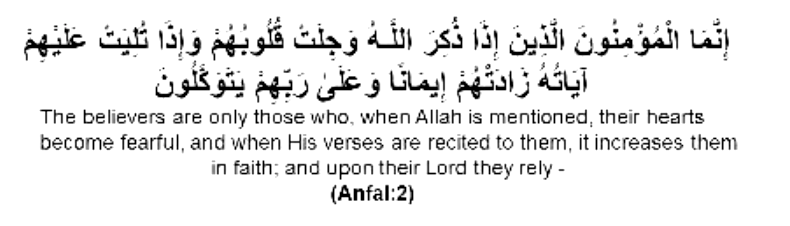
This is an ayah about imaan increasing and decreasing. When Quran is recited, their hearts tremble and their imaan goes up. So that means imaan is variable in intensity. Some people think quality of imaan goes up and down and some think quantity of imaan goes up and down. Imam shaafi thinks its quantitative and units of imaan go up and down. Imam abu hanifa thinks quality and passion of imaan goes up and down.

This ayah says that don't say you have imaan, say you have Islam. So what is the difference between Islam and Imaan? One position is that Islam and Imaan are identical when used separately and are different when used together, together imaan means what's in the heart and islam means the outward practices.

The hadith says nobody does adultery while being a momin. Does that mean Imaan leaves the heart if we commit major sins? Does this apply only to adultery or to all major sins? Does the Iman return after completing the act of sin?

This hadith says that Iman has branches. Does that mean imaan has components? What are the components? Do we need to have all components?
We need to build a workshop to answer all of these questions.
BOUNDARIES OF IMAN
INCLUSIVISM
Everyone who calls himself a Muslim, has Islam
EXCLUSIVISM
Some people are excluded from Islam e.g. all Ulema agree that a person is excluded from Iman if he believes there is another Prophet after Prophet ﷺ. We can coexist peacefully with groups who have these beliefs, but these groups should not claim to be a Muslim. A Muslim cannot claim to be an Orthodox Christian. A Jew cannot open a synagogue and call it a church. A muslim cannot call his mosque a Catholic church. It is not freedom of religion to claim someone else’s identity.
PLURALISM AND TOLERANCE
There are many theological sects in the Muslim world. How do you set boundaries?
Recommended reading: Boundaries of theological tolerance in Islam - Dr Shermen Jackson (OUP)
Ilm ul kalaam is the study of Iman. Ilm ul kalaam are the analytical discussions based on Quran and Sunnah
Ilm ul fiqh is the study of Islam. Ilm ul fiqh is the textual understanding of Islam based on Quran and Sunnah about how to follow deen practically
Ilm ul tasawwuf/tazkiya is the study of Ihsan. Ilm ul tazkiyah and tasawwuf is about creating feelings of Ihsan, to stand before Allah as if we are looking at him or He is looking at us.
Heart - a feeling that lies in the heart only
Tongue - expression of imaan with their tongue by saying the kalimah
Heart+tongue - truly believe in their heart and express on tongue
Heart+tongue+actions - believe in heart, express with their tongue and manifest in their actions
Friday, January 1, 2016
Seerah of the Prophet صلی اللہ علیہ وسلم - Why Study the Seerah?
Why Study the Seerah?
The Prophet SAWW is the leader and the Sayyid of mankind. He is the best person to live on Earth.
Where to study the seerah from?
1-The Quran
2-All of the ahadith
3-Books about seerah(starting from the sahaba and tabaeen, but the earliest sources are not saved because of the lack of resources for printing. Ibn e Ishaq and Ibn e Hisham are one of the earliest sources. Ibn e Ishaq wrote huge volumes and with their isnaad and chain of narrators. Ibn e Hisham made a summarized version of the seerah. Now we cannot find Ibn e Ishaq's book. The seerah was summarized by Ibn e Hisham because it was hard to make copies of the extremely lengthy book by hand. Ibn e Ishaq's book was just hundred years after the death of Prophet SAWW which is even before the books of ahadith.
4-Shamails are books about the specialties and characters of Prophet SAWW e.g. shamail e tirmidhi
5- Miracles of the prophethood e.g. Dalail e Nabuwwah of Bayhiqi
PRE-ISLAMIC ARABIA
Most Arabs have become Arabs through culture and not pure ancestry.
Arab al Baiyda(extinct Arabs): Earliest civilizations that lived in Arabia thousands of years ago e.g. Aad and Samood. They lived in the land which was later called Arabia. Samood is the earliest humanity in Arabia.
Arab al Baqiyah(remaining Arabs) have two categories:
Two tribes: Qahtan and Adnan
QAHTAN is the father of Arabs. His son was Yarab from which Arab comes. Arabic language is traced to Yarab. Majority opinion says that Qahtan goes back to one of the sons of Nooh AS(Saam). Semites are the descendants of Saam and they are Hebrews. Nooh AS had three sons but this is not completely authentic but one of his sons led to African lineage, one to Caucasian lineage,and one led to Qahtan and Arabs. Another minority opinion is that Qahtan is the son of Ibrahim and an even weak opinion is that Qahtan is the son of Hud AS. Qahtanis lived in Southern Arabia and had a number of dynasties e.g. Sabaa, Aus and Khazraj
ADNAN is the ancestor of our Prophet SWS. Adnan is one of the descendants of the Prophet Ismael AS. Eventually they go back to the same son of Nooh AS. Ismael AS is Iraqi. Ismael AS married into Qahtanis and began speaking their language Arabic and his children are a merger. All of the Arab tribes e.g. Quraysh are from Adnan. Adnan was the 20th grandfather of Prophet SWS. The followers are called Arab al mustaraba because they learnt Arabic and they became even more eloquent than Arab al Aariba.
RELIGIOUS STATUS OF THE WORLD BEFORE ISLAM
M
- Allah has put this obligation on us. Over 50 verses command us to take the Prophet SAWW as an example. Indeed there is for you in the Prophet SAWW an exemplary character. We look at this example for all spheres of life and deen.
- It is the best way to increase our love for the Prophet SAWW and it is also a demonstration of our love for the Prophet SAWW. A sign of loving someone is the desire to know more about the person.
- It helps us to understand the Quran because the Quran has to be understood in its context. Every Surah has a shaan e nuzool and a context of revelation which is understood through the seerah.
- The seerah lifts our spirits and gives us optimism. It helps us to practise Islam in this age of fitnah. The persecution we face is not even close to the persecution the sahaba RAS faced so it gives us a lot of strength. Allah also used to tell stories of the prophets to the Prophet SAWW to give him hope.
- The biggest of his miracles is his seerah. His seerah and the transformation of arabs through his seerah is a beautiful proof of his prophethood SAWW.
- Seerah lays out a methodology for the revival of the Ummah. We should follow his methodology if we want to revive the ummah. He SAWW began from scratch and built an Islamic state. Studying seerah gives us insight into the best generation that ever lived(RadiAllahu anhum wa Radhu anh). The Prophet SAWW said the best ummah is by ummah. Allah chose the purest heart for prophethood and other pure hearts for sahabah.
- Studying the seerah will arm us to defend the Prophet SAWW against false claims of the kuffaar and the atheists. It will allow us to understand many things that are misused to create controversy.
The Prophet SAWW is the leader and the Sayyid of mankind. He is the best person to live on Earth.
Where to study the seerah from?
1-The Quran
2-All of the ahadith
3-Books about seerah(starting from the sahaba and tabaeen, but the earliest sources are not saved because of the lack of resources for printing. Ibn e Ishaq and Ibn e Hisham are one of the earliest sources. Ibn e Ishaq wrote huge volumes and with their isnaad and chain of narrators. Ibn e Hisham made a summarized version of the seerah. Now we cannot find Ibn e Ishaq's book. The seerah was summarized by Ibn e Hisham because it was hard to make copies of the extremely lengthy book by hand. Ibn e Ishaq's book was just hundred years after the death of Prophet SAWW which is even before the books of ahadith.
4-Shamails are books about the specialties and characters of Prophet SAWW e.g. shamail e tirmidhi
5- Miracles of the prophethood e.g. Dalail e Nabuwwah of Bayhiqi
PRE-ISLAMIC ARABIA
Most Arabs have become Arabs through culture and not pure ancestry.
Arab al Baiyda(extinct Arabs): Earliest civilizations that lived in Arabia thousands of years ago e.g. Aad and Samood. They lived in the land which was later called Arabia. Samood is the earliest humanity in Arabia.
Arab al Baqiyah(remaining Arabs) have two categories:
Two tribes: Qahtan and Adnan
QAHTAN is the father of Arabs. His son was Yarab from which Arab comes. Arabic language is traced to Yarab. Majority opinion says that Qahtan goes back to one of the sons of Nooh AS(Saam). Semites are the descendants of Saam and they are Hebrews. Nooh AS had three sons but this is not completely authentic but one of his sons led to African lineage, one to Caucasian lineage,and one led to Qahtan and Arabs. Another minority opinion is that Qahtan is the son of Ibrahim and an even weak opinion is that Qahtan is the son of Hud AS. Qahtanis lived in Southern Arabia and had a number of dynasties e.g. Sabaa, Aus and Khazraj
ADNAN is the ancestor of our Prophet SWS. Adnan is one of the descendants of the Prophet Ismael AS. Eventually they go back to the same son of Nooh AS. Ismael AS is Iraqi. Ismael AS married into Qahtanis and began speaking their language Arabic and his children are a merger. All of the Arab tribes e.g. Quraysh are from Adnan. Adnan was the 20th grandfather of Prophet SWS. The followers are called Arab al mustaraba because they learnt Arabic and they became even more eloquent than Arab al Aariba.
RELIGIOUS STATUS OF THE WORLD BEFORE ISLAM
M
Sunday, November 29, 2015
Types of friends mentioned in the Quran
ü The
literal meanings of a friend-be there for a friend whenever your friend needs
you.
1.
WALLI (The Protector, The Helper)
o A
friend who cares for you, when you are in trouble and he guides you.
o Another
word used for this type of friend is HAMEEM, literal meaning extreme heat. Means a friend with whom
you have great intimacy, with her you
feel warm & comfortable.
Surah Baqrah Ayah # 257.
اللَّهُ وَلِيُّ الَّذِينَ ءَامَنُوا
يُخْرِجُهُمْ مِنَ الظُّلُمَاتِ إِلَى النُّورِ وَالَّذِينَ كَفَرُوا
أَوْلِيَاؤُهُمُ الطَّاغُوتُ يُخْرِجُونَهُمْ مِنَ النُّورِ إِلَى الظُّلُمَاتِ
أُولَئِكَ أَصْحَابُ النَّارِ هُمْ فِيهَا خَالِدُون
“Allah
is the walli of those who believe. HE brings them out from darkness into
light.But as for those who disbelieve, their Walis are Taghut, they bring them
out from light into darkness. Those are the dwellers of the Fire, and they will
abide therein forever.”
Note : We are required to be a walli and hameem with our
siblings, cousins and enemies. We have to tolerate their misbehavior.
2.SADDIQUE from sidq (Truthful)
o
A genuine friend, who is your friend for your sake, not to get any kind of benefit from you.
o
The one who never gives up on you when you start making mistakes.
- Remains
in touch with you even if you establish a distance with them because of their
honesty.
- Continuously
feel pain for you.
- Who
supports you at every moment (for the good).
- Who is
your Shafa’ee.
Surah An-Nisa, Ayah # 69
ومَنْ يُطِعِ اللَّهَ وَالرَّسُولَ فَأُولَئِكَ
مَعَ الَّذِينَ أَنْعَمَ اللَّهُ عَلَيْهِمْ مِنَ النَّبِيِّينَ وَالصِّدِّيقِينَ
وَالشُّهَدَاءِ وَالصَّالِحِينَ وَحَسُنَ أُولَئِكَ رَفِيقًا
“
And those who obey Allah the Messenger, then they will be in the company of
those on whom Allah has bestowed His Grace, of the Prophets, the Siddiqun, the
martyrs, and the righteous. And how excellent these companions are!”
3. SAHIB (The person sitting
next to you)
o It’s a casual acquaintance or someone who is
looking out for you.
- Concerned
about you.
- Tries
to help you to the best of her ability.
- The
more she spends time with you, the more she knows you and your emotions.
Surah Al-Baqarah, Ayah # 81
& 82
بَلَى مَنْ كَسَبَ سَيِّئَةً وَأَحَاطَتْ بِهِ
خَطِيئَتُهُ فَأُولَئِكَ أَصْحَابُ النَّارِ هُمْ فِيهَا خَالِدُونَ
“ Yes!
Whosoever earns evil and his sin has surrounded him, they are
dwellers
of the fire; they will dwell therein forever.”
وَالَّذِينَ ءَامَنُوا وَعَمِلُوا الصَّالِحَاتِ
أُولَئِكَ أَصْحَابُ الْجَنَّةِ هُمْ فِيهَا خَالِدُونَ
“And
those who believe and do righteous good deeds, they are dwellers of Paradise,
they will dwell therein forever.”
4.WALEJA comes from the word
Walaja (To Penetrate)
- A
friend who is a partner in your business.
- Involved
in every matter of your life
- It’s a
very close type of friendship and is rare.
- Extreme
trust is involve in this kind of
friendship.
- Allah
سبحانہ و تعالی is our Waleja. HE put us in trials to see
what role He has in our lives.
- The
Prophetصلی اللہ علیہ و آلیہ
وسلم is our Waleja
according to how much we are acting upon his sunnah. His sunnah must be
followed in each and every sphere of our life.
- Finally,
if you have Allah سبحانہ و تعالی and HIS Messenger صلی اللہ علیہ و آلیہ وسلم as Waleja in your life than Allah
سبحانہ و تعالی will let in true believers as
waleja in your life.
Surah At-Taubah, Ayah # 16,
َمْ حَسِبْتُمْ أَنْ تُتْرَكُوا وَلَمَّا
يَعْلَمِ اللَّهُ الَّذِينَ جَاهَدُوا مِنْكُمْ وَلَمْ يَتَّخِذُوا مِنْ دُونِ
اللَّهِ وَلَا رَسُولِهِ وَلَا الْمُؤْمِنِينَ وَلِيجَةً وَاللَّهُ خَبِيرٌ بِمَا
تَعْمَلُونَ
“
Do you think that you shall be left alone while Allah has not tested those among
you who have striven hard and fought and have not taken Walijah besides Allah
and His Messenger, and the believers. Allah is well-Acquainted with what you
do.”
5. BITA’ANA from Batan (Secret)
- A
friend who keeps your secrets.
- يَاأَيُّهَا الَّذِينَ
ءَامَنُوا لَا تَتَّخِذُوا بِطَانَةً مِنْ دُونِكُمْ لَا يَأْلُونَكُمْ
خَبَالًا وَدُّوا مَا عَنِتُّمْ قَدْ بَدَتِ الْبَغْضَاءُ مِنْ أَفْوَاهِهِمْ
وَمَا تُخْفِي صُدُورُهُمْ أَكْبَرُ قَدْ بَيَّنَّا لَكُمُ الْآيَاتِ إِنْ
كُنْتُمْ تَعْقِلُونَ
“
O you who believe! Take not as Bitanah (advisors, consultants, protectors,
helpers, friends) those outside your religion since they will not fail to do
their best to corrupt you. They desire to harm you severely. Hatred has already
appeared from their mouths, but what their breasts conceal is far worse. Indeed
We have made plain to you the verse if you understand.”
Note : According to scholars
“Don’t share your secrets with every friend, make it sure that you share your
secrets with the right person who can keep it and help you.”
6.QAREEN from Qaran (Always
moving together)
- A
friend with whom you have a lot in common.
- Both
always think alike.
- Qareen
can be bad, but when she becomes bad you should be a Sadique or Sahib but
no more a Qareen now.
Surah As-Saffat ,Ayah # 51
قَالَ قَائِلٌ مِنْهُمْ إِنِّي كَانَ لِي
قَرِينٌ
“A
speaker of them will say: “Verily, I had a companion (in the world)”
Continuation
يَقُولُ أَئِنَّكَ لَمِنَ الْمُصَدِّقِينَ
52:
Who used to say : Are you among those who believe (in resurrection after
death).
أَئِذَا مِتْنَا وَكُنَّا تُرَابًا وَعِظَامًا
أَئِنَّا لَمَدِينُونَ
53:
“ (That) when we die and become dust and bones, shall we indeed (be raised
up to receive reward or punishment
(according to our deeds)?”
قَالَ هَلْ أَنْتُمْ مُطَّلِعُونَ
54:
“ (The speaker) said: “Will you look down?”
فَاطَّلَعَ فَرَآهُ فِي سَوَاءِ الْجَحِيمِ
55:
“So he looked down and saw him in the midst of the Fire.”
قَالَ تَاللَّهِ إِنْ كِدْتَ لَتُرْدِينِ
56:
“He said : “By Allah ! You have nearly ruined me.”
TWO BEST KINDS OF FRIENDS
7. KHALEEL from Khullah
(Penetrate into Your Heart)
- Always
thinks about you, even when you are not with her.
- Rare
category.
- Ibrahim
AS was a Khaleel to Allah سبحانہ و تعالی
- Make
those people your friend who has Taqwa.
Surah An-Nisa, Ayah # 125
وَمَنْ أَحْسَنُ دِينًا مِمَّنْ أَسْلَمَ
وَجْهَهُ لِلَّهِ وَهُوَ مُحْسِنٌ وَهُوَ مُحْسِنٌ وَاتَّبَعَ مِلَّةَ
إِبْرَاهِيمَ حَنِيفًا وَاتَّخَذَ اللَّهُ إِبْرَاهِيمَ خَلِيلًا
Who
can be better in religion than one who submits his whole self to Allah, does
good, and follows the way of Abraham the true in Faith? For Allah did take
Abraham for a friend.
8. RAFEEQ from Rafaq (with whom you feel relaxed)
- A
friend with whom you feel relaxed and get comfort in her company.
- You
can be yourself in her company there’s no need to be artificial in their
presence.
Surah An- Nisa Ayah # 69
مَنْ يُطِعِ اللَّهَ وَالرَّسُولَ فَأُولَئِكَ مَعَ
الَّذِينَ أَنْعَمَ اللَّهُ عَلَيْهِمْ مِنَ النَّبِيِّينَ وَالصِّدِّيقِينَ
وَالشُّهَدَاءِ وَالصَّالِحِينَ وَحَسُنَ أُولَئِكَ رَفِيقًا
All
who obey Allah and the messenger are in the company of those on whom is the
Grace of Allah,- of the prophets (who teach), the sincere (lovers of Truth),
the witnesses (who testify), and the Righteous (who do good): Ah! what a
beautiful fellowship!
TWO BAD KINDS OF FRIENDS
MENTIONED IN THE QURAN
9.KHAZOUL from Khazala
(Deception)
- Who
only acts like a friend.
- At
convenient times remains with you, but when you in trouble that kind of
friend disappears.
- Deceitful
like Shaytan.
Surah Al- Furqan Ayah # 29
لَقَدْ أَضَلَّنِي عَنِ الذِّكْرِ بَعْدَ إِذْ
جَاءَنِي وَكَانَ الشَّيْطَانُ لِلْإِنْسَانِ خَذُولً
He
did lead me astray from the Message (of Allah) after it had come to me! Ah! the
Evil One is but a traitor to man!
10.KHADAN from Akhdan (feels
attracted)
- This
kind of friendship is between girls and boys.
- Strongly
prohibited in Islam.
Surah An-Nisa Ayah # 25
وَمَنْ لَمْ يَسْتَطِعْ مِنْكُمْ طَوْلًا أَنْ
يَنْكِحَ الْمُحْصَنَاتِ الْمُؤْمِنَاتِ فَمِنْ مَا مَلَكَتْ أَيْمَانُكُمْ مِنْ
فَتَيَاتِكُمُ الْمُؤْمِنَاتِ وَاللَّهُ أَعْلَمُ بِإِيمَانِكُمْ بَعْضُكُمْ مِنْ
بَعْضٍ فَانْكِحُوهُنَّ بِإِذْنِ أَهْلِهِنَّ وَءَاتُوهُنَّ أُجُورَهُنَّ
بِالْمَعْرُوفِ مُحْصَنَاتٍ غَيْرَ مُسَافِحَاتٍ وَلَا مُتَّخِذَاتِ أَخْدَانٍ
فَإِذَا أُحْصِنَّ فَإِنْ أَتَيْنَ بِفَاحِشَةٍ فَعَلَيْهِنَّ نِصْفُ مَا عَلَى
الْمُحْصَنَاتِ مِنَ الْعَذَابِ ذَلِكَ لِمَنْ خَشِيَ الْعَنَتَ مِنْكُمْ
وَأَنْتَصْبِرُوا خَيْرٌ لَكُمْ وَاللَّهُ غَفُورٌ رَحِيم
If
any of you have not the means wherewith to wed free believing women, they may
wed believing girls from among those whom your right hands possess: And Allah
hath full knowledge about your faith. Ye are one from another: Wed them with
the leave of their owners, and give them their dowers, according to what is
reasonable: They should be chaste, not lustful, nor taking paramours:
when they are taken in wedlock, if they fall into shame, their punishment is
half that for free women. This (permission) is for those among you who fear
sin; but it is better for you that to practice self-restraint. And Allah is
Oft-forgiving, Most Merciful.
Most important thing is that try
to have the best qualities of all these types of friends. Be the one with whom
others can find comfort and warmth.
Subscribe to:
Posts (Atom)